Engineering Cliffside Decks for West Lake Hills Canyon Lots
Cliffside, canyon-edge, and hillside lots define West Lake Hills deck construction. Top Notch Deck Builder engineers each build around the limestone bedrock substructure, the city’s heritage oak ordinance, and the view-preservation HOA standards that govern lots across Eanes ISD.
Request Free Estimate
West Lake Hills isn’t a typical Austin neighborhood. The terrain ranges from gentle slopes to the active canyon edge, with limestone bedrock close to the surface and heritage oak preservation rules that govern every footing placement. Most deck builders quote over the phone call. On a West Lake Hills lot, that’s how you end up with a deck that can’t pass tree ordinance review or has post placements that didn’t account for the bedrock.
We’ve worked across the major West Lake Hills neighborhoods: Tarrytown-adjacent streets along Westlake Drive, the cliffside lots along Camp Craft and Greenlee, the canyon-edge homes near Bee Cave Road, and the established neighborhoods around Eanes Elementary. Every deck starts with a site assessment that maps soil depth, bedrock, drainage, and tree root systems.
If you’re planning a deck project in West Lake Hills, call (512) 215-3767 or request a free at-home consultation to start at Phase 1.
Neighborhoods We Serve in West Lake Hills
West Lake Hills covers a compact incorporated city of about 1.3 square miles, but the terrain varies dramatically from street to street. Here’s where we work most often.
Westlake Drive corridor. The older established core of West Lake Hills has mature trees, mixed lot sizes, and varied slopes.
Camp Craft Road area. Cliffside and canyon-edge lots dominate. Bedrock is often within 2 to 4 feet of grade, and many lots back to limestone outcrops.
Bee Cave Road properties. The southern edge of West Lake Hills has newer construction and larger lots. Slope drops toward the Bee Cave Road corridor on many parcels, with multi-level deck builds common on the steeper lots.
Eanes Elementary district. The family-oriented core of West Lake Hills. Wooded lots with significant heritage oak coverage.
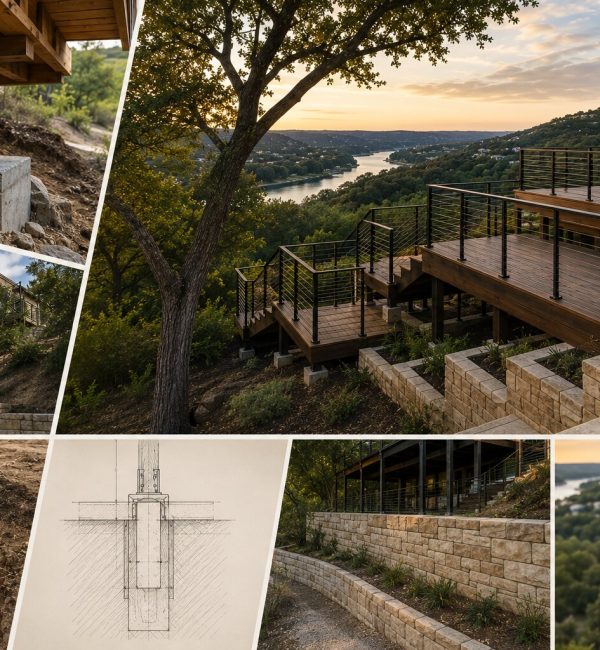
West Lake Hills Terrain and Engineering Considerations
Three terrain factors define almost every West Lake Hills deck project.
Limestone bedrock close to the surface. Most West Lake Hills lots have bedrock within 2 to 6 feet of grade. Standard 4-foot footings sometimes hit rock before reaching design depth. We’ll use bedrock-anchored footings, helical piers, or shallow, bell-shaped footings, depending on what the site assessment reveals. See deck foundation engineering for the footing strategies we run on bedrock-close lots.
Heritage oak preservation. West Lake Hills has strict tree preservation ordinances. Heritage oaks (and several other protected species) cannot be removed without city approval, and footing placement near drip lines requires careful planning. We’ll map protected trees during site assessment and design footings around root systems.
Cliffside and canyon-edge lots. Many West Lake Hills properties have a significant drop in grade or a canyon edge. These need hillside deck engineering with proper lateral bracing, anchoring, and sometimes retaining walls. Cantilevered builds over canyon edges add another layer of structural design, often paired with elevated deck construction for vertical drop sections. For lots with a moderate grade rather than a canyon drop, sloped lot deck construction handles the elevation transition.
View preservation matters in West Lake Hills. Cable rail and glass rail systems preserve sightlines on canyon-edge lots. Many homes face downtown Austin or canyon vistas, and the choice of deck guardrail affects the daily experience of the view. See custom deck features for guardrail material details.
Materials That Work in West Lake Hills
Material selection in West Lake Hills usually balances Hill Country aesthetic with longevity in canyon-edge exposure.
Cedar is the traditional choice. Cedar deck construction fits the Hill Country aesthetic, ages naturally, and pairs well with the limestone-and-oak landscape that defines West Lake Hills.
Ipe and other hardwoods work for premium builds with extended lifespans, especially on canyon-edge lots where UV exposure is intense.
Composite decking has grown significantly in West Lake Hills over the past decade. Modern composite withstands canyon-edge sun and eliminates the annual staining schedule wood requires. It’s the maintenance-free option. PVC products (AZEK, TimberTech AZEK) handle west-facing exposure especially well.
Cable rail and glass rail. View-lot deck builds almost always specify cable or glass guardrail systems. They’re the standard for canyon-edge sightlines.
HOAs and Permits in West Lake Hills
West Lake Hills is its own incorporated city, not unincorporated Travis County. That means a separate permit process, separate tree ordinance review, and separate setback requirements from the City of Austin.
Our permit partners handle the West Lake Hills paperwork, including tree preservation submittals, structural permit applications, and inspection coordination. Permit timelines run 3 to 5 weeks in most cases, longer if heritage oak preservation review is required.
Some West Lake Hills neighborhoods have HOAs covering architectural review, but coverage is patchy. Many lots have no HOA at all. Where HOAs apply, we’ll prepare the architectural review submission in accordance with the specific neighborhood’s requirements.
How We Engineer West Lake Hills Builds
Every West Lake Hills deck follows the same five-phase build process we use for all client work, with city-specific additions for the bedrock survey, tree-preservation mapping, and permit coordination.
Phase 1 site assessment runs longer in West Lake Hills than on flat metro lots. Bedrock probing, tree mapping, and grade survey can add 3 to 5 days to the standard assessment. It’s a longer Phase 1 than typical Austin lots, but it’s what the terrain demands. We’ll deliver a structural plan that accounts for what the assessment actually found, not what a typical Austin deck plan assumes.
Construction timelines depend on terrain. Standard sloped lots run 2 to 4 weeks. Cliffside and canyon-edge builds with retaining or cantilever work run 4 to 8 weeks.
Frequently Asked Questions About West Lake Hills Deck Builds
Do we need a separate permit for West Lake Hills?
Yes. West Lake Hills is its own incorporated city with its own building department, separate from the City of Austin. All deck projects above 30 inches require a city permit. There are no exceptions for small builds. Our permit partners handle the application, scheduling, and inspections directly with West Lake Hills.
How do you handle the limestone bedrock under West Lake Hills lots?
Site assessment includes bedrock probing at each potential post location. It’s the difference between a deck that holds up and one that shifts after the first dry season. When bedrock sits close to grade, we’ll switch from standard concrete pier footings to bedrock-anchored footings, helical piers, or shallow, bellied footings, depending on rock conditions. The structural plan from Phase 1 specifies which footing type goes where.
What about heritage oak trees and tree preservation rules?
West Lake Hills has strict tree preservation ordinances. We’ll map all protected trees during the site assessment, design footings around their root systems, and submit any required tree-preservation documentation as part of the permit package. Heritage oak removal requires city approval and isn’t typically granted for deck projects.
Are there HOAs in West Lake Hills?
Coverage varies by neighborhood. Some areas have active HOAs with architectural review requirements; other lots have no HOA at all. We’ll confirm HOA status during the initial site visit and handle architectural submission if needed.
What's the typical timeline for a West Lake Hills deck build?
From first call to final walkthrough, typical builds run 10 to 14 weeks: 1 to 2 weeks design and proposal, 3 to 5 weeks city permit (longer if tree preservation review applies), 2 to 4 weeks standard construction, longer for cliffside or canyon-edge builds. Tree preservation review can add 2 to 4 weeks if the deck affects protected trees.
Can you build on cliffside or canyon-edge lots?
Yes. Cliffside and canyon-edge builds are common in West Lake Hills, especially along Camp Craft and the western canyon corridor. These require hillside deck engineering with proper lateral bracing, post anchoring to bedrock where possible, and sometimes retaining wall integration. Cantilever sections over canyon edges add additional structural design.
What deck materials work for West Lake Hills view preservation?
Cable rail and glass rail systems preserve view sightlines on canyon-edge lots. For decking surface, cedar fits the Hill Country aesthetic and ages naturally; composite (especially PVC products) handles full canyon-edge sun and reduces maintenance. We’ll review samples in your space during the design phase to match the existing home and landscape.
Schedule a West Lake Hills Site Visit
Every West Lake Hills consultation starts with walking the lot, probing for bedrock, mapping protected trees, and identifying view orientation. We’ll deliver a structural plan tailored to your specific lot, not a generic deck quote. Call (512) 215-3767 or fill out the form to schedule your free at-home consultation. Fully insured. 4.9 average rating. One-year workmanship warranty on every build.