Designing Multi-Level Decks for Austin Hillside and Flat Lots
Sloped, hillside, and flat lots throughout Austin all support multi-level deck construction when engineered for use, with consideration of sightlines, code-compliant stairs, and structural connections. Top Notch Deck Builder designs each platform to function independently while integrating as a whole.
Request Free Estimate
A multi-level deck isn’t just a bigger deck. It’s two, three, or four decks that share structure and stairs, each one doing a different job. The upper platform handles cooking and conversation. The middle holds dining. The lower wraps around the pool or steps down to the yard. Done right, the layout flows. Done wrong, you’ve built three disconnected platforms with awkward transitions and code problems at every step.
We’ve built 500+ decks across Central Texas, including dozens of multi-level builds across the Hill Country and Austin metro. From two-level walkout-basement decks in Westlake to four-level cascade builds on Lake Travis cliffsides, every multi-level project starts with the homeowner’s use of each platform. The layout follows the use; the structure follows the layout.
If you’re planning more than one deck level, or trying to figure out whether your lot needs one, the design starts with seeing the terrain. Call (512) 215-3767 or request a free at-home consultation.
When Multi-Level Makes Sense
Multi-level construction solves problems that single-platform decks can’t.
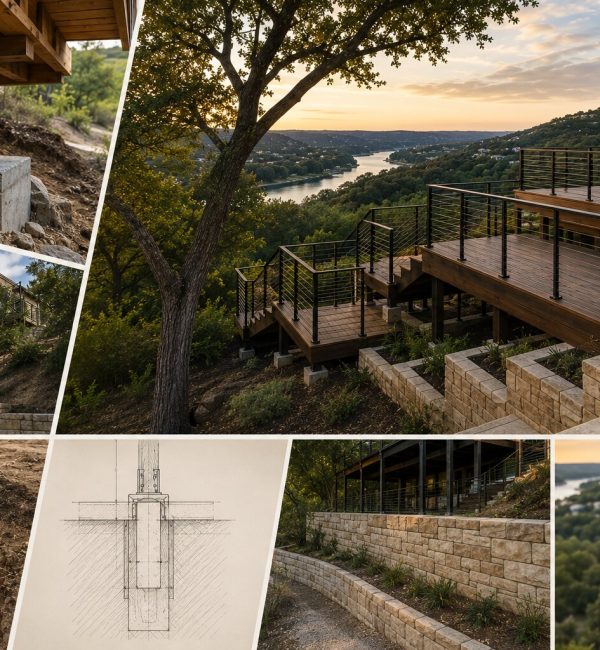
The most common driver is grade. On a sloped lot, a single-platform deck either sits too high at the back or too low at the front. Multi-level design steps the deck down with the grade so each level lands at the right elevation for its use. Common in sloped lot deck construction and almost every hillside deck build we do.
The second driver is the use of separation. A homeowner with a busy kitchen wants the grill near the back door, but doesn’t want it next to the dining table. Multi-level layouts give each function its own platform with natural flow between them.
The third driver is view optimization. Different levels see different things. The upper frames the canyon view; the lower frames the lake view.
The fourth driver is space efficiency. On small lots, going up is often the only way to add usable square footage. An elevated upper level over a covered patio doubles the footprint without expanding the property.
Multi-Level Deck Layouts We Build
Different lots and different homeowners call for different layouts. Here are the most common types.
Two-Level Walkout Decks
The upper level is at house elevation, the lower level is at yard elevation, connected by a single stair run. Common for walkout basement homes and houses with a significant rear-yard slope. Often pairs with elevated deck construction where the upper deck sits above 30 inches.
Stepped Cascade Decks
Three or four platforms that step down the grade in sequence. Each platform has a different use: the upper for cooking, the middle for dining, the lower for lounging, and the terrace for the pool. Common on Hill Country lots with significant grade drops. We’ll engineer each level independently while sharing footings and ledger connections where possible.
Wrap-Around Multi-Level
The deck wraps the house in an L- or U-shaped configuration, with different elevations on each side. The east side catches the morning sun at one elevation; the west side catches the sunset at another. Requires careful corner detailing and lateral bracing tied through the corner posts.
Multi-Level with Pool Surround
The upper deck holds cooking and dining, and the lower platform serves as a pool surround at coping height. Requires drainage management between levels and pool-rated decking materials on the lower platform.
Mixed-Material Multi-Level
Different levels in different materials. Composite for the high-traffic upper level, wood for the lower lounge area, and stone hardscape for the ground-level patio. We’ll also incorporate custom deck design elements, such as built-in benches between levels.
Structural Considerations for Multi-Level Builds
Multi-level construction adds engineering that single-platform builds don’t see.
Stair design and code compliance. Each stair run must meet the IRC code requirements: rise/run dimensions, handrail height, and graspability. We’ll engineer every stair run individually and include it in the structural plan.
Shared structural connections. Where two levels meet, framing handles load from both. We’ll design these connections with proper hardware, not just doubled boards. Connection failure at a multi-level junction can drop both levels.
Drainage between platforms. Water from the upper level has to drain somewhere. We’ll build slight pitches into the framing, route runoff away from the lower level, and design the gap between levels to drain through or around. This draws on our deck foundation engineering work, since drainage and footing protection are linked.
Independent guardrail systems. Each platform above 30 inches in grade needs its own code-compliant guardrail. We’ll standardize the rail style across all levels for visual unity and engineer post connections at each platform.
Code-compliant lighting. Multi-level decks need integrated lighting on every stair run. We’ll design lighting with the structure, not as an afterthought.
Where We Build Multi-Level Decks
Multi-level construction is common across our service area, but heaviest in the Hill Country and walkout-basement neighborhoods.
Hill Country priority: West Lake Hills, Lakeway, Lake Travis, Rough Hollow, The Hills of Lakeway, Steiner Ranch, Westlake, Dripping Springs, and Bee Cave.
Walkout-basement neighborhoods: Northwest Hills, Tarrytown, Travis Heights, and older parts of Westlake have layouts that naturally call for two-level decks.
Larger flat-lot homes: parts of Cedar Park, Round Rock, and Georgetown have flat lots large enough to justify multi-level layouts purely for use separation, even without a grade drop.
How We Engineer the Build
Every multi-level project follows our build process with extra attention to how the platforms connect.
Site Survey and Layout Planning
A free at-home visit to map grade drops, identify use zones, and discuss how each platform will function. We’ll diagram the layout before we get to structural specs.
Structural Plan
Footing depths, post heights for each platform, beam sizing, lateral bracing, stair routing, and connection hardware. You’ll see every platform elevation and every stair run.
Permit and HOA Submission
Our permit partners handle the City of Austin paperwork. For HOA architectural review in Hill Country communities, we’ll submit drawings to spec.
Build and Final Walkthrough
Typically, three to five weeks for a two-level build, longer for three or four levels. We’ll finish with a walkthrough of every platform, every stair run, and every connection.
Frequently Asked Questions About Multi-Level Decks
When does a deck become a multi-level deck?
Any time the deck has two or more distinct platforms at different elevations connected by a stair run. The smallest version is a two-level walkout deck. The largest builds we’ve done are four-level cascades stepping down Hill Country grade drops. Anything beyond a single platform with one stair run to grade counts as multi-level.
How much more does a multi-level deck cost than a single-level deck?
Multi-level builds typically run 30 to 60 percent more per square foot than equivalent single-level construction because of the additional engineering, multiple guardrail systems, code-compliant stair runs, and shared structural connections. The exact difference depends on the number of levels, material choice, and lot complexity.
Can you build a multi-level deck on a flat lot?
Yes, and we do regularly. On flat lots, multi-level construction is about separating uses rather than transitioning grades. The upper level handles cooking and dining, and the lower level handles the lounge or pool surround. Each platform is engineered as its own structure, connected by a stair run.
How does drainage work between deck levels?
We design drainage into the framing. The upper platform pitches slightly, so water runs to one side rather than through the gap to the lower platform. The gap between levels is engineered to route runoff away from the lower deck surface, often into a perimeter drainage zone that ties into yard drainage.
Do multi-level decks need more permits?
Usually, one permit covers the whole build, but the plan review is more involved because the structural connections and stair runs need to comply with the IRC code at each level. Our permit partners handle the application. The permit timeline runs about the same as a single-level build (two to four weeks).
How do you handle the visual transitions between levels?
Material continuity and rail consistency. Most multi-level builds use the same decking material across all levels, even if some levels see lower use. The guardrail style stays consistent across platforms. Stair stringers and risers match the deck surface or contrast intentionally for visual interest.
How long does a multi-level deck build take?
Two-level walkout decks typically run three to five weeks of active construction. Three-level cascades take five to seven weeks to build. Four-level builds or jobs with significant retaining work run seven to ten weeks. Add two to four weeks for permits before construction starts.
Schedule a Free Multi-Level Deck Consultation
Multi-level builds start with understanding how you’ll use each platform. We’ll come walk your lot, talk through the use zones, evaluate the grade, and tell you what’s structurally feasible. Call (512) 215-3767 or fill out the form to schedule your free at-home consultation. Fully insured. 4.9 average rating. One-year workmanship warranty on every build.