Engineering Lakefront Decks for Lake Travis Frontage Owners
Lakefront construction on Hudson Bend, Comanche Trail, and Briarcliff means coordinating LCRA shoreline permits, multi-jurisdictional approvals, and terraced multi-tier deck construction from house to water. Top Notch Deck Builder handles all three on Lake Travis lots.
Request Free Estimate
Lake Travis isn’t a single city. It’s a 64-mile reservoir touching Lakeway, Bee Cave, Spicewood, Briarcliff, Volente, Lago Vista, and Jonestown. The deck permit could come from any of seven building departments, and the LCRA (Lower Colorado River Authority) handles all shoreline work.
We’ve built across both shores: Hudson Bend, Comanche Point, Hurst Creek, Briarcliff, Spicewood, Volente, Lago Vista, and Jonestown. Every deck factors in which jurisdiction issues the permit, what the LCRA needs, and how the variable water level affects setbacks.
If you’re planning a deck project on Lake Travis, call (512) 215-3767 or request a free at-home consultation to start at Phase 1.
Communities Around Lake Travis
Lake Travis touches a dozen distinct communities, each with its own permit jurisdiction, HOA situation, and terrain pattern.
South shore. Hudson Bend, Comanche Trail, Comanche Point, Hurst Creek, and the broader Lakeway corridor. It’s the most active deck construction along the lake. Slopes drop steeply to the water, often requiring hillside deck engineering. Permit jurisdiction varies: Lakeway City or Travis County.
Briarcliff and Spicewood. Further west, with larger lots and lower density. Briarcliff is its own incorporated village with a separate permit process. Spicewood is mostly unincorporated Travis County.
North shore. Volente, Lago Vista, and Jonestown. Less developed than the south shore, larger lots, lower prices. Lago Vista has its own city permit process.
Steiner Ranch corridor. Above the lake on the south shore, with HOA architectural review and view lots without direct lakefront.
Lake Travis Terrain and Water-Level Considerations
Three factors define almost every Lake Travis deck project.
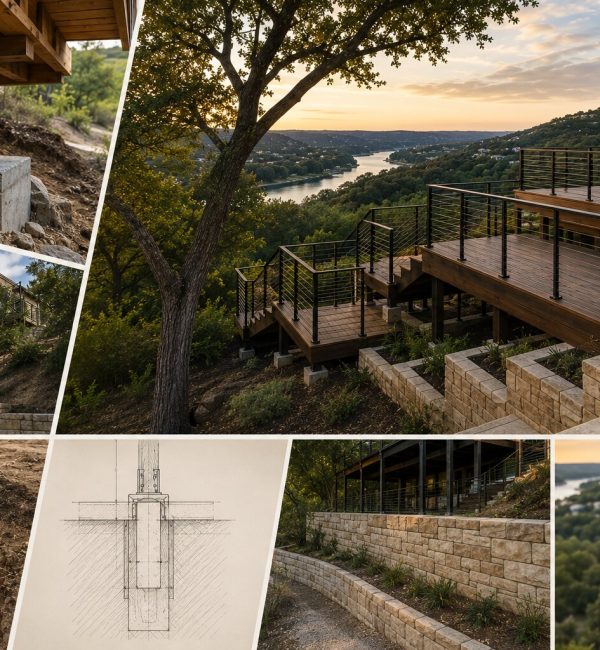
The Hill Country slope drops to the lake. Most Lake Travis lots have a significant grade drop from house to water, often 40 to 100 feet or more. It’s the dominant terrain factor on lakefront builds. Some need sloped lot deck builds for moderate grades; others need multi-level deck construction with terraced platforms that step down the slope.
Lake Travis water-level fluctuation. Lake Travis is a flood-control reservoir that fluctuates dramatically with drought and rain. In 2023, the lake dropped over 60 feet below full pool; in 2024 and 2025, it refilled. We’ll factor the LCRA’s regulatory full-pool elevation (681 feet above sea level) into setback measurements, not the actual current water line.
LCRA shoreline regulation. Anything below the 681-foot line is LCRA jurisdiction. It’s the regulated zone. That includes retaining walls below the full-pool elevation, deck sections extending over the regulated zone, boat-dock connections, and any in-water construction. The LCRA review process runs separately from the city or county building permit.
Materials for Lake Travis Lakefront Builds
Lake Travis lots combine three material stressors that most Austin decks don’t face simultaneously: heavy UV from open-water reflection, sustained humidity from a lake-edge microclimate, and frequent water exposure from rain, splashes, and pool overflow.
Composite decking, especially PVC-based products (AZEK Vintage, TimberTech AZEK), handles the combined UV plus humidity load well. It’s the most common choice for lakefront builds because it eliminates the maintenance burden.
Ipe and tigerwood. Premium hardwoods that hold up to 40+ years of lake exposure. Naturally resistant to rot, insects, and humidity. Higher upfront cost, but the dimensional stability matters when the deck connects to fixed boat dock structures.
Cedar works for shaded lake-edge decks but needs aggressive staining (every 12 to 18 months instead of 18 to 24). See wood deck construction for cadence. Stainless fasteners (minimum 305 grade; 316 for direct water exposure) are required regardless of the decking material.
LCRA, Jurisdictions, and the Permit Maze
The Lake Travis permit situation is more complex than any other location in the Austin area.
Building permits come from whichever city or county the lot is in. It’s address-dependent: Lakeway, Briarcliff, Lago Vista, Jonestown, Travis County, Burnet County, or Austin’s ETJ, depending on the parcel. Each has its own application process, fee schedule, and inspection requirements. Our permit partners route the application to the right jurisdiction.
LCRA shoreline review applies regardless of which city or county issues the building permit. Any structure below the 681-foot elevation requires LCRA review, which takes 4 to 12 weeks.
For HOA architectural review (Steiner Ranch, Rough Hollow, smaller lake communities), see our HOA submission workflow.
How We Engineer Lake Travis Builds
Every Lake Travis deck follows our standard five-phase build process, with Lake Travis-specific additions for LCRA coordination, multi-jurisdictional permitting, and slope-to-shoreline engineering.
Phase 1 site assessment includes shoreline survey verification. We’ll confirm where the 681-foot line crosses the property and probe the soil for foundation engineering decisions on the slope.
Phase 2 design emphasizes UV plus humidity performance. We’ll bring composite and PVC samples to compare in actual lake-edge conditions.
Phase 3 permit coordination runs both tracks in parallel: building permit through the local city or county, plus LCRA shoreline review. For builds requiring cable rail to preserve lake views, see custom deck features.
Construction timelines: standard slope-to-shoreline builds run 4 to 8 weeks; multi-tier terraced builds with retaining run 6 to 12 weeks; elevated deck construction, with cantilever sections, adds design time.
Frequently Asked Questions About Lake Travis Deck Builds
Which city or county issues permits for Lake Travis lakefront deck projects?
Depends on the specific address. Lake Travis touches Lakeway, Briarcliff, Lago Vista, Jonestown, parts of unincorporated Travis County, parts of Burnet County, and Austin’s ETJ. Each jurisdiction has its own permit process. Our permit partners route the application to the correct city or county based on the parcel. LCRA shoreline review applies separately regardless of building permit jurisdiction.
How does Lake Travis water level fluctuation affect deck construction?
We engineer to the LCRA full-pool elevation (681 feet above sea level) regardless of where the actual water line sits during construction. In drought years (like 2023, when the lake dropped 60+ feet below full pool), the actual shoreline can be hundreds of feet from the regulated boundary. We’ll never set deck footings below the regulated 681-foot line, even when the visible water is far below it. There’s no exception during drought. The lake refills, and the regulatory boundary is what matters. That’s the rule.
What's the LCRA review process for shoreline structures?
The LCRA reviews any permanent structure below the 681-foot full-pool elevation. That includes retaining walls, deck sections extending over the regulated zone, boat dock framing connections, and any in-water construction. The submission requires drawings, material specifications, and erosion control plans for in-water work. Review runs 4 to 12 weeks. We’ll prepare the LCRA package as part of standard permit coordination.
Do you build terraced multi-tier decks from the house down to the lake?
Yes, regularly. Lake Travis slopes often drop 40 to 100 feet from the house to the water, and terraced, multi-tier decks turn that grade into usable outdoor space. Each tier has its own structural plan, with footings sized for the grade and soil conditions. Stairs between tiers must meet rise-and-run code, sometimes requiring extra landings on steep runs.
What deck materials hold up to sustained lake-edge humidity and UV?
PVC composite (AZEK Vintage, TimberTech AZEK) and ipe hardwood are the two top performers for combined humidity-plus-UV exposure. PVC eliminates water absorption; ipe has natural resistance to rot and insects. Both pair with stainless 305 or 316 fasteners. Cheap ones corrode within 2 to 3 years in lake-edge humidity. Standard composite-core absorbs moisture at edges. Cedar requires tighter staining than inland decks.
Can you handle erosion control or retaining walls on lake-slope lots?
Yes. Many Lake Travis builds need retaining walls to hold the slope before deck construction can start. We’ll coordinate the retaining wall design with the deck structural plan so the wall and deck work as a single system. Retaining walls below the 681-foot elevation require LCRA review separately from the building permit. For walls above the full pool, the building permit covers them.
What's the difference between Lake Travis north shore and south shore properties?
South shore (Lakeway, Hudson Bend, Briarcliff, Spicewood) is closer to the Austin metro, and that’s where most deck activity sits. Higher land prices, steeper grade drops to water. North shore (Volente, Lago Vista, Jonestown) is less developed, has larger lots, and grade drops are usually gentler. It’s the more affordable corridor. Permit jurisdictions differ: the south shore mostly Lakeway city or Travis County; the north shore has Lago Vista city plus Travis and Burnet counties. We work on both shores regularly.
Schedule a Lake Travis Site Visit
Every Lake Travis consultation starts with a walk-through of the lot, identifying the 681-foot regulatory line, confirming which jurisdiction handles permits, and assessing the slope-to-shoreline terrain. We’ll deliver a structural plan that reflects your specific lot and the LCRA setback requirements. Call (512) 215-3767 or fill out the form to schedule your free at-home consultation. Fully insured. 4.9 average rating. One-year workmanship warranty on every build.