Building Lakeway Decks for The Hills and Lake Travis Lots
Lake Travis frontage, west-facing afternoon sun, and Hill Country grade drops define Lakeway deck construction. Top Notch Deck Builder engineers each build around the specific lot orientation, the HOA architectural review (The Hills of Lakeway, Rough Hollow Modifications Committee), and the LCRA water-level setbacks that govern lakefront properties.
Request Free Estimate
Neighborhoods We Serve in Lakeway
Lakeway is a sprawling city covering everything from lakefront homes to inland subdivisions five miles from the water. Terrain, exposure, and HOA situations vary dramatically depending on which part of Lakeway you’re in.
Lakefront homes along Hudson Bend and the Lake Travis shoreline represent the most engineering-intensive Lakeway builds. Water-level setbacks, hillside deck construction for the slope down to the lake, and full west-facing sun exposure all apply.
The Hills of Lakeway is the largest architectural review community in the city, with strict standards on materials, colors, and height. We’ll handle the architectural submission package as part of the project.
Older Lakeway neighborhoods (Lakeway Drive corridor, Flintrock Falls, Lake Travis estates) feature established homes, mature trees, and a mix of HOA situations. Some have architectural review, others don’t. Costa Bella and smaller subdivisions also have active architectural review processes that we regularly submit to.
Rough Hollow Yacht Club Community
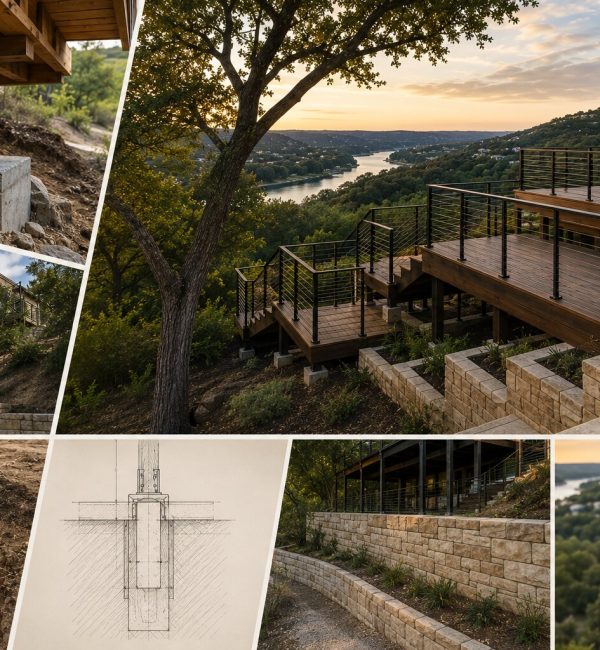
Rough Hollow is a 2,000-acre master-planned community within the Lakeway city limits, anchored by the Rough Hollow Yacht Club & Marina on the south shore of Lake Travis. The community spans roughly 1,000 homes across multiple villages, with newer construction standards that differ from those in older Lakeway neighborhoods. Hillside lots with significant grade drop toward Lake Travis dominate the inventory, and most deck builds integrate the lake view as the primary design consideration.
The Rough Hollow Modifications Committee operates separately from The Hills of Lakeway architectural review. Submission requirements include material specifications, color palette compliance, and view-corridor preservation, all factored into approval. Yacht Club community members often build pool-integrated decks that face the marina; non-member hillside properties still benefit from Lake Travis sightlines that drive cable rail and multi-level deck design. Review timelines run 4 to 6 weeks, faster than The Hills because the Committee meets twice monthly.
We’ve built across Rough Hollow’s hillside inventory, Marina-adjacent flat lots, and the larger Wave Lake-area properties. It’s a market where lake-view orientation drives the entire deck design.
Lakeway Terrain and Exposure Considerations
Three factors define almost every Lakeway deck project across both Rough Hollow and the older neighborhoods.
West-facing Texas sun. Most Lakeway lots orient toward the lake, which means west-facing exposure for the primary deck. Afternoon sun on a west-facing Texas deck regularly exceeds 100 degrees in summer. Standard composite-core boards run uncomfortably hot in full afternoon sun; PVC-based composite handles it significantly better. It’s the heat-resistant choice.
Lake Travis water-level setbacks. Lakefront lots have setback requirements from the lake measured at full-pool elevation (681 feet above sea level). The Lower Colorado River Authority (LCRA) and the City of Lakeway both regulate setbacks for permanent structures. We’ll coordinate with the survey to confirm where the deck footprint can sit.
The Hill Country slope drops to the lake. Many Lakeway lots have a significant grade drop from house to lake. Some need straightforward sloped lot deck builds; others need elevated pier construction to create usable terraces down the slope.
Materials That Work in Lakeway
Material selection in Lakeway is driven more by sun exposure and view orientation than by aesthetics. Composite decking using PVC-based systems (AZEK, TimberTech AZEK) is the strongest performer for west-facing Lakeway decks. Surface temperature runs 15 to 25 degrees cooler than composite-core boards. Ipe and tigerwood hardwoods withstand lake-edge UV exposure for 40-plus years and run cooler underfoot than composites. Cedar works well for shaded interior Lakeway lots and shaded sections of larger decks. See wood deck construction for the staining cadence. Cable rail and glass rail are standard for lake-view positions because they preserve the view across the deck guardrail. See custom deck features for guardrail specifications.
HOAs and Permits in Lakeway
Lakeway is its own incorporated city in Travis County. It’s a separate permit process from the City of Austin, with its own setbacks and inspection schedule. The Hills of Lakeway is the dominant ARC in the city, handling architectural review through a Modifications Committee that meets monthly. Submission timing matters: submit before the meeting and your project reviews will be at that meeting; submit the day after, and you’ll wait nearly a month. The Rough Hollow Modifications Committee meets twice monthly with similar package requirements. See our HOA architectural review workflow. Lakefront lots have additional LCRA requirements: setback measurements and any in-water construction require separate LCRA review beyond the city permit.
Engineering-First Approach in Lakeway
Every Lakeway deck follows the same five-phase build process we use across all client work, with city-specific additions for HOA architectural review, LCRA coordination on lakefront lots, and west-facing exposure planning. Phase 1 site assessment includes exposure mapping. We’ll note the deck orientation, the sun path across the deck footprint, and any view corridors that drive guardrail decisions. For lakefront lots, the assessment also includes verification of the water-level setback against the existing lot survey. Construction timelines depend on HOA scope: standard non-HOA builds run 6 to 10 weeks pre-construction; The Hills of Lakeway builds run 8 to 14 weeks pre-construction; Rough Hollow runs 6 to 10 weeks because the Committee meets more frequently.
Frequently Asked Questions
What deck materials hold up best for Lakeway's west-facing sun and lake exposure?
PVC-based composite (AZEK Vintage, TimberTech AZEK, Fiberon Paramount) outperforms composite-core products in west-facing Lakeway exposure. Surface temperature runs 15 to 25 degrees cooler in full sun. Ipe hardwood is the premium alternative with similar heat performance and a 40-plus-year lifespan. We’ll bring samples to your site so you can compare surface temperatures directly.
Do you build in the Rough Hollow Yacht Club community?
Yes. Rough Hollow is one of our most active Lakeway markets. We’ve built across the hillside inventory, the Marina-adjacent flat lots, and larger Wave Lake-area properties. The Rough Hollow Modifications Committee operates separately from The Hills of Lakeway, with detailed submission requirements and twice-monthly meetings, which speeds review compared to The Hills. We’ve coordinated multiple Rough Hollow builds through that ARC process.
How do you handle Lake Travis water-level setback requirements?
Lakefront lots have setback requirements measured from the 681-foot full-pool elevation. The LCRA regulates anything below that line, and the City of Lakeway regulates the lot-side setbacks. We’ll coordinate with the existing lot survey or commission a new survey to verify where the deck footprint can sit. For any deck section near the setback line, the structural plan reflects the regulated boundary.
Do you submit to The Hills of Lakeway architectural review committee?
Yes, regularly. The Hills Modifications Committee handles hundreds of submissions a year. We’ll prepare the full architectural review package per the committee’s specifications, submit it on your behalf, respond to revision requests, and coordinate approval timing with the construction schedule.
Does Lakeway have its own permit process separate from Austin?
Yes. Lakeway is its own incorporated city with its own building department. All deck projects above 30 inches require a city permit. Our permit partners handle Lakeway paperwork directly. Lakefront projects also require LCRA review for any work that affects the water-level setback area.
What's the difference between The Hills, Rough Hollow, and older Lakeway?
The Hills of Lakeway is the largest gated architectural review community, with monthly Modifications Committee review and strict materials standards. Rough Hollow is the newer south-shore master-planned community with its own Modifications Committee that meets twice monthly. Older Lakeway neighborhoods (Lakeway Drive corridor, Flintrock Falls) have varied HOA coverage. It’s a mix: some lots have architectural review, others don’t. We’ll confirm HOA status during the initial site visit.
Can you integrate decks with pools, boat docks, or marina structures?
Yes. It’s standard scope in Lakeway because of the lake-house architecture. We’ll coordinate the deck framing with the pool surround, design for chemical exposure at the pool edge, and route any utilities through the framing. Boat dock connections require LCRA coordination since the dock extends past the water-level setback line.
How long does HOA architectural review add to a Lakeway project?
For The Hills of Lakeway, plan for 4 to 8 weeks of review time before construction can start. For Rough Hollow, 4 to 6 weeks, because the Committee meets twice monthly. About 60 percent of submissions receive revision requests; we’ll respond within 5 business days and resubmit. For older Lakeway lots without HOA review, only the city permit timeline (2 to 4 weeks) applies.
Schedule a Lakeway Site Visit
Every Lakeway consultation starts with a walk-through of the lot, identifying sun exposure and view orientation, confirming HOA status (The Hills of Lakeway, Rough Hollow, or an older neighborhood), and verifying water-level setbacks for lakefront lots. We’ll deliver a structural plan that reflects what your specific Lakeway lot needs. Call (512) 215-3767 or request your free at-home consultation. Fully insured. 4.9 average rating. One-year workmanship warranty on every build.