Engineering Decks for Leander's Hillside and Master-Planned Lots
Crystal Falls, Bryson, Larkspur, and Mason Hills define Leander deck construction across the city’s hillside transition zone. Top Notch Deck Builder engineers each build around the mixed-soil profile, the Leander ISD family demographic, and the active HOA architectural review in master-planned communities.
Request Free Estimate
Leander's Hillside Transition Zone
Leander sits at the western edge of Williamson County, where Blackland Prairie clay meets Edwards Plateau limestone, and the geology shifts more dramatically across the city than across Cedar Park or Round Rock. Western neighborhoods like Crystal Falls, Travisso, and parts of Bryson sit on rolling limestone topography where deck foundations anchor into bedrock at 12 to 24 inches. Eastern Leander, including Block House Creek and Caballo Ranch, transitions back toward clay-prairie engineering similar to Cedar Park specifications. We’ll walk the lot and probe the soil before committing to footing depth.
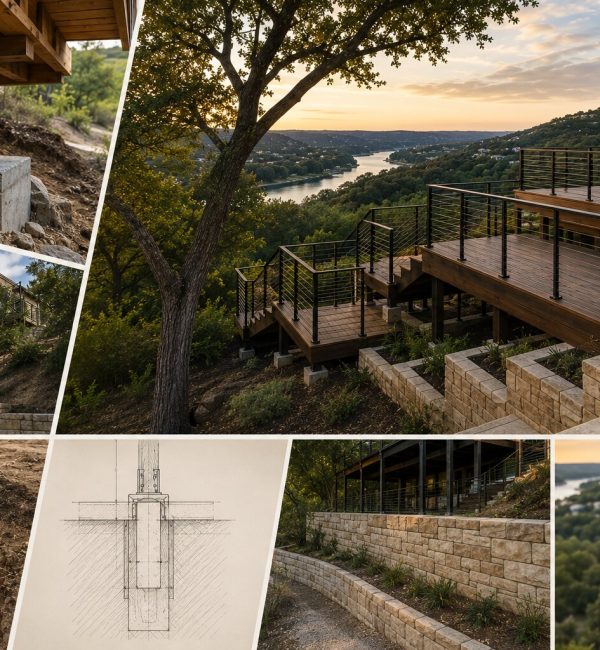
The hillside topography on Leander’s west side drives multiple engineering decisions that don’t apply to flatter Williamson County markets. Grade drop across a single lot can range from 8 to 15 feet, which means sloped-lot construction techniques apply throughout Crystal Falls and Travisso rather than only on individual exception lots. Retaining wall integration, stair-step deck layouts, and elevated pier construction all show up regularly on Leander west-side projects. We’ve engineered builds that span a 20-foot vertical drop from the house to the lower deck level.
Master-Planned Community Coverage
Crystal Falls is Leander’s largest master-planned community, spanning thousands of homes across multiple villages and decades of development. Newer Crystal Falls sections feature smaller lots with closer setbacks; older sections include larger lots with mature landscaping and greater deck design flexibility. Bryson, Larkspur, Mason Hills, and Reagan’s Overlook represent the newer master-planned wave, with active deck-building demand across all four. Highlands at Mayfield Ranch and Vista Ridge round out the master-planned landscape on the city’s southern edge.
Travisso anchors the custom-grade end of Leander deck construction. The community sits on a hillside with significant view-lot inventory, and the architectural review committee operates closer to custom-home standards than to typical HOA review. It’s a market where multi-level deck construction and pool-deck integration show up more often than in production-builder Leander neighborhoods. We’ve coordinated multiple Travisso builds through the community’s specific ARC process, and we’ll handle revisions when requested.
HOA Architectural Review in Leander
Leander’s HOA architectural review processes vary widely across the city. Crystal Falls operates a centralized ARC that reviews submissions from all villages within the community. Each Crystal Falls village has slightly different aesthetic standards, but the submission package format is consistent. Travisso operates under the strictest review process, mirroring custom-home standards. Bryson, Larkspur, Mason Hills, and Reagan’s Overlook each maintain their own ARC with smaller-scale formal processes.
We’ll prepare submissions in each HOA’s format and handle revisions when requested. Block House Creek, Caballo Ranch, and Sandy Creek have older or smaller HOAs with simpler approval workflows, but still require written sign-off before construction starts. Newer master-planned communities tend to have more formal architectural review than older Leander neighborhoods, so the submission timeline can range from 2 to 8 weeks depending on the community.
Leander ISD-Driven Family Priorities
Leander ISD is one of the primary draws for families relocating into the city, and outdoor priorities reflect the family-focused demographic. Pool decks and pool-deck integration dominate larger lots in Crystal Falls and Travisso. Multi-level decks with separate zones for adult entertaining and family play are common in Bryson and Larkspur. Screened porches and covered patios appear on most family-focused builds. It’s a different engineering scope from the entertainment-focused builds we deliver on smaller urban lots in Austin.
Material Selection for Leander Decks
Material choice across Leander correlates with neighborhood demographics and lot geometry. Composite decking using Trex, TimberTech, and Fiberon dominates Crystal Falls and the newer master-planned communities, where family lifestyle priorities favor low maintenance over wood aesthetics. Cedar and ipe appear more often in Travisso custom-home contexts and on older Block House Creek lots where mature landscaping pairs naturally with wood. We’ve also built pool decks using stone pavers and stamped concrete across multiple Crystal Falls and Travisso pool installations.
Engineering-First Approach in Leander
Most Leander deck builders run a production-build model with templated designs that don’t account for the city’s hillside topography or the variance across master-planned communities. Top Notch Deck Builder works engineering-first across our five-phase build process: site survey, structural plan, permit and HOA coordination, construction, and final walkthrough. The west-side hillside lots especially benefit from this approach, since templated production builds frequently fail on slopes greater than 4 feet of grade drop. We’ll design each project around the specific lot geometry rather than fitting it to a standard plan.
Frequently Asked Questions
What HOAs in Leander require architectural review for decks?
All master-planned communities require written ARC approval. Crystal Falls (a centralized community across multiple villages), Travisso, Bryson, Larkspur, Mason Hills, Reagan’s Overlook, Highlands at Mayfield Ranch, and Vista Ridge all maintain active architectural review committees. Travisso operates under the strictest review standards, approaching near-custom-home standards. Block House Creek and Caballo Ranch use simpler approval forms but still require pre-construction sign-off.
How does Leander's hillside topography affect deck construction?
Western Leander sits on Edwards Plateau limestone with rolling topography. Grade drops of 8 to 15 feet across a single lot are common in Crystal Falls and Travisso. Multi-level deck construction, retaining wall integration, and elevated pier engineering apply to most west-side projects rather than only to exceptional lots. Templated production-build approaches frequently fail on slopes greater than 4 feet of grade drop. We’ll design each Leander project around the specific lot geometry, and we won’t apply a single template across the catalog.
Do you build in Crystal Falls?
Yes. Crystal Falls is Leander’s largest master-planned community and represents a significant portion of our recent project volume. The centralized ARC reviews submissions from all villages within the community, with a consistent submission package format across villages and slight aesthetic variations from village to village. We’ve coordinated multiple Crystal Falls builds through the ARC and understand what each village expects.
What's the typical footing depth for a Leander deck?
Footing depth varies across Leander’s mixed soil profile. Western neighborhoods sitting on Edwards Plateau limestone often anchor into bedrock at 12 to 24 inches with rock pinning. Eastern neighborhoods transitioning back to Blackland Prairie clay may require 30- to 36-inch footings, similar to Cedar Park specifications. We’ll probe each lot during the site visit before specifying the footing depth.
How is Leander different from Cedar Park for deck construction?
Leander sits on more dramatic geology than Cedar Park, with the western edge on Edwards Plateau limestone and the eastern edge on Blackland Prairie clay. Cedar Park stays mostly on the clay-loam transition. Leander also has more recent master-planned community development (Crystal Falls, Bryson, Larkspur) and the custom-grade hillside Travisso community, none of which have direct equivalents in Cedar Park. The hillside topography on Leander’s west side drives different engineering decisions than the flatter Cedar Park lots.
Are permits required for Leander decks?
Yes, for any deck attached to the house or any deck above 30 inches off grade. The City of Leander operates its own building department, which handles permits within city limits. Properties in Williamson County ETJ permits through the county. Crystal Falls, Travisso, Bryson, and the other master-planned HOAs all require ARC approval before the permit application gets submitted. We’ll coordinate all permit work as part of the project scope.
Do you work in Travisso?
Yes. Travisso is one of Leander’s most distinctive markets for deck construction. The hillside terrain creates significant grade-drop engineering challenges, the architectural review committee operates closer to custom-home standards than typical HOA review, and view-lot inventory drives demand for multi-level and pool-integrated decks. We’ve coordinated multiple Travisso builds through the ARC process.
What's the typical Leander deck timeline?
Standard Leander deck builds run 2 to 4 weeks of active construction. Permit timeline adds 2 to 4 weeks (Leander city) or 3 to 5 weeks (Williamson County ETJ). HOA architectural review adds 4 to 8 weeks for Crystal Falls and the smaller master-planned HOAs. Travisso’s custom-grade ARC reviews can run 6 to 10 weeks for hillside or pool-integrated projects. We’ll plan the schedule around the homeowner’s calendar.
Schedule a Leander Site Visit
Every Leander consultation starts with walking the lot, probing for soil profile, evaluating grade drop, confirming jurisdiction (Leander city vs Williamson County ETJ), and reviewing HOA architectural standards. We’ll deliver a structural plan that reflects your specific lot, neighborhood requirements, and the way your family will actually use the deck. Call (512) 215-3767 or fill out the form to schedule your free at-home consultation. Fully insured. 4.9 average rating. One-year workmanship warranty on every build.