Foundation Engineering for Austin Clay Soil and Bedrock Lots
Expansive clay, Hill Country bedrock, and sloped grade dictate deck foundation engineering across Austin. Top Notch Deck Builder designs every footing based on the specific soil profile, drainage routing, lot grade, and structural loads above to keep decks level for decades.
Request Free Estimate
The foundation is what makes a deck last. We’ve replaced decks built with off-the-shelf footings that lifted three inches in a wet year, twisted apart within five seasons, or pulled away from the house entirely when the soil shrank back. The fix isn’t better lumber, it’s better engineering.
Austin sits on some of the most active clay soil in the country. The same soil that cracks driveways and tilts garage slabs is the same soil that holds up your deck. Without footings designed around that movement, the deck moves with it. We’ve built 500+ decks across Central Texas and spent 15 years engineering foundations that anchor below the active soil zone and remain level through wet and dry years.
Whether you’re on cliffside bedrock in West Lake Hills, rural slopes in Dripping Springs, or pure clay in central Austin, the engineering changes for each. Call (512) 215-3767 or request a free at-home consultation to walk your lot with us.
Why Austin Soil Demands Engineered Footings
Most builders use the same footing for every job. We start with the soil.
Austin’s expansive clay swells and contracts with every wet-and-dry cycle. The top 18 to 36 inches is the active zone where moisture changes cause the most movement. A standard 18-inch footing sits inside that active zone and rides up and down with the seasons. By year three, the deck isn’t level. By year five, the connections are stressed.
Engineered footings anchor below the active zone. For most of central Austin and the inner suburbs, that means a minimum depth of 36 inches, sometimes 48 inches on lots with deeper clay or poor drainage. The footing also needs the right diameter to handle the live load from the deck above, as well as the lateral forces from wind and use.
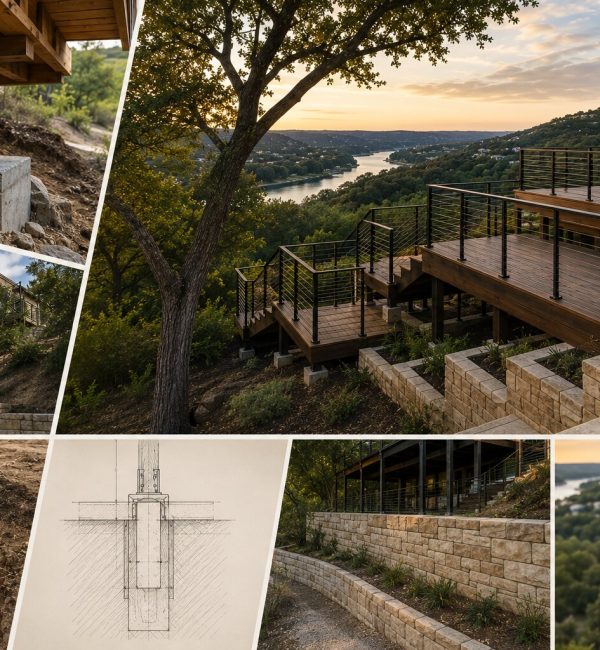
On lots with a significant slope, the engineering gets more complex. Sloped lot deck construction often combines footing design with grade transitions, drainage management, and structural retaining work. Cliffside-view lots add a layer of considerations for hillside deck construction, including bedrock anchoring and view-optimized post placement.
We’ll test soil conditions during the site assessment and design every footing around what we find. No standard sizes, no copied specs from a previous job.
Foundation Methods We Use
Different lots need different footings. Here’s what we work with.
Standard Concrete Footings
A poured concrete pier extending below the active soil zone. Typical depth 36 to 48 inches in Austin clay, with diameter calculated from the load. We’ll use this for most flat-lot builds where soil is consistent and drainage is good.
Helical Piers
Steel shafts with helical plates that get screwed into the ground to a specified depth and torque. Great for sloped lots, lots with poor drainage, or jobs where excavation is impractical. Helical piers anchor below the active zone reliably and install faster than concrete footings. We’ll use them for sloped lots, lots with poor drainage, or jobs where excavation is impractical.
Belled Footings
A poured footing with a wider base at the bottom (the bell) to handle higher loads or to prevent uplift in expansive soil. We’ll use belled footings for elevated builds, where a smaller-diameter shaft sits on a wider base, distributing load across a larger soil area.
Bedrock Anchoring
Hill Country lots often hit limestone bedrock within a few feet of the surface. When bedrock is present, we’ll anchor footings directly using rock anchors or pin piles. Common for elevated deck work in Westlake, Lake Travis cliffside lots, and parts of Lakeway.
Reinforced Pads
For very large multi-level builds, we sometimes pour reinforced concrete pads that distribute load across multiple footing points. This is the same engineering approach used for our multi-level deck designs.
How We Engineer Every Foundation
Every foundation follows our build process, with a specific focus on the structural decisions made before any concrete pours.
Soil Assessment
A free at-home visit to identify soil type, depth of the active clay zone, drainage patterns, and any visible bedrock. We’ll also identify trees with root systems that could affect footing placement.
Load Calculation
We calculate the live load (people, furniture, weather), dead load (the deck structure itself), and lateral load (wind, use) for every post location. The bigger the deck and the higher the elevation, the more load each footing carries.
Footing Design
Based on soil profile and load, we specify the depth, diameter, footing type, and reinforcement for every post location. You’ll see this on the structural plan before we break ground.
Inspection Coordination
Most Austin jurisdictions require footing inspection before pouring. Our permit partners handle the City of Austin paperwork. For HOA architectural review in communities like Steiner Ranch and Rough Hollow, we submit footing plans as part of the architectural package.
Where Foundation Engineering Matters Most
Austin’s geology varies more than most homeowners realize. The foundation that works in Round Rock may not work in Lake Travis.
Central Austin and Older Suburbs
Deep expansive clay, often 6 to 10 feet of active soil before a stable substrate. Engineered footings typically run 36 to 48 inches deep with careful drainage planning.
Hill Country Corridor
Bedrock starts closer to the surface in parts of West Lake Hills, Westlake, and the western edge of Austin. Cliffside lots above Lake Travis often allow rock anchoring directly into limestone, which is faster to install than concrete piers and provides excellent long-term stability.
Rural Hill Country
Dripping Springs, Spicewood, and the outer Hill Country mix bedrock, clay pockets, and significant slope. We’ll typically use a hybrid of helical piers and rock anchors, depending on what we find at each post location.
Suburban Edge
Round Rock, Pflugerville, Cedar Park, and Hutto sit on relatively consistent clay with manageable drainage. Standard engineered concrete footings work for most builds in these areas, though sloped lots still require attention.
Frequently Asked Questions About Deck Foundation Engineering
How deep do deck footings need to be in Austin?
Almost always at least 36 inches in central Austin and the inner suburbs, often deeper on lots with significant slope or poor drainage. The depth depends on where the active soil zone ends and where the footing can anchor in stable substrate. We design depth around each site, not from a standard spec.
What's a helical pier, and when do you use one?
A helical pier is a steel shaft with helical plates that get screwed into the ground to a specified depth and torque. We use them for sloped lots, lots with poor drainage, jobs where excavation is impractical, or any time concrete pier installation would damage existing landscaping. They install faster and anchor reliably below the active soil zone.
Does my deck really need engineered footings?
If your deck sits above 30 inches grade at any point, has more than 200 square feet of usable surface, or sits on a sloped or hillside lot, yes. Engineered footings prevent the seasonal lift-and-drop that destroys decks built on standard 18-inch piers. They also satisfy permit requirements and pass inspection without callbacks.
What if my lot has bedrock close to the surface?
Bedrock anchoring is faster and often cheaper than concrete piers. We drill into the limestone, set rock anchors or pin piles, and tie the deck framing directly to the bedrock. This is common on Hill Country builds in West Lake Hills, Westlake, and along the Lake Travis corridor.
Can you add a deck onto an existing concrete foundation or patio slab?
Sometimes, depending on the slab. Most residential patio slabs aren’t designed to handle deck loads, especially elevated structures. We’ll typically install new footings adjacent to or through the slab, anchoring below it. We’ll inspect the existing slab during the site assessment and let you know what’s feasible.
How long do engineered footings last?
Properly designed footings should outlast the deck above. Concrete piers below the active soil zone, helical piers at the correct depth, and rock anchors set in limestone all have multi-decade lifespans. We back every foundation we install with a one-year workmanship warranty.
What's the difference between a footing and a foundation?
In residential deck terms, the footing is the individual point that bears the load (typically a concrete pier or helical pier). The foundation is the system of all footings, beams, and connections that transfers deck load to the ground. We engineer the whole foundation system, not just individual footings.
Get a Free Foundation Assessment
If you’re planning a deck, the foundation is the first thing we’ll talk about. We’ll look at your lot, identify the soil conditions, and walk you through the footing options that make sense for your terrain and your build. Call (512) 215-3767 or fill out the form to schedule your free at-home consultation. Fully insured. 4.9 average rating. One-year workmanship warranty on every build.