Most homeowners hire a deck contractor once, maybe twice in a lifetime. That limited experience means they arrive at the first conversation carrying assumptions that feel reasonable but routinely cost them money, delay their project, or leave them with a structure that doesn’t perform the way they expected. Understanding where those assumptions break down is the most practical thing you can do before you pick up the phone.
The Lowest Bid Is Not the Best Starting Point
Price comparison is natural, but treating the lowest number as the benchmark almost always backfires. A bid that comes in significantly under the others is usually missing something: thinner decking boards, undersized footings, hardware that corrodes within a few years, or labor from a crew without the licensing and insurance your municipality requires. When a contractor skips the permit process to save time and money, you inherit that risk. Selling a home with an unpermitted deck in Old West Austin, Austin, TX can trigger costly remediation or force you to tear the structure down entirely.
A realistic budget for a professionally built wood deck in the Austin area runs roughly $25 to $45 per square foot for standard configurations, and composite materials push that range higher, often $40 to $65 per square foot or more depending on the brand and complexity. Those numbers include permits, footings, framing, decking, and basic railings. If a quote lands well below that range without a clear explanation, ask exactly what is being left out.
Top Notch Deck Builder has observed that customers who chase the lowest price frequently call back six to eighteen months later asking about repairs that cost more than the original savings. Getting the scope of work in writing, line by line, is the only way to compare bids honestly.
Permits and Site Conditions Are Not Formalities
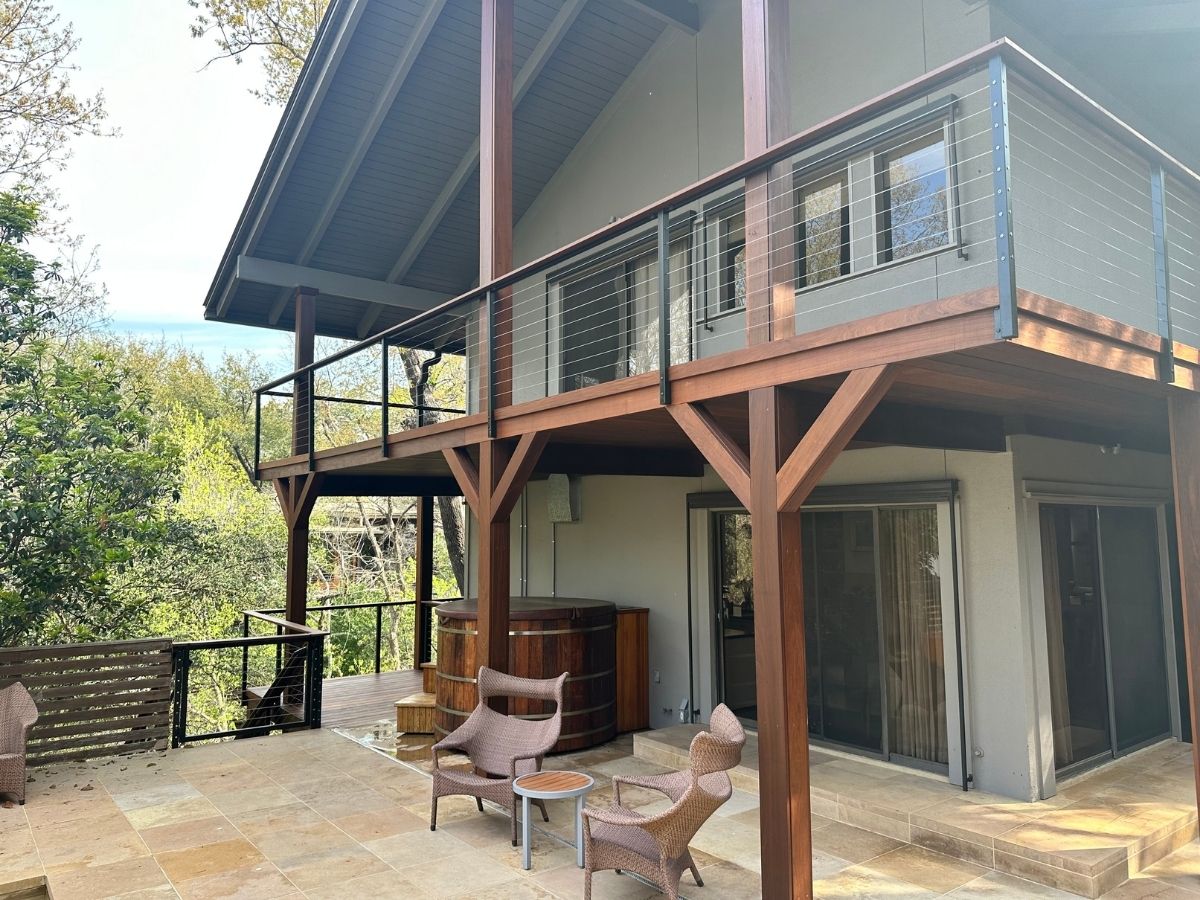
A surprising number of homeowners assume permits are optional paperwork that a contractor handles quietly in the background. They are not optional, and they are not background noise. The City of Austin requires permits for most attached decks and for freestanding structures above a certain height. Inspections at the footing stage, the framing stage, and final completion exist because a deck carries real load, and the connections to your home’s ledger board are structurally critical.
Soil conditions add another layer of complexity. Austin’s expansive clay soil moves with moisture changes, which means footings need to be sized and placed with that movement in mind. A contractor who pours footings without accounting for soil type is setting up a structure that will shift, crack, or pull away from the house over time. If your yard has significant slope, the engineering requirements change further. Building on a sloped lot requires careful footing placement and often a more complex framing plan than a flat yard of the same square footage.
If your property falls under HOA oversight, there is another approval layer before a contractor can break ground. Working with an HOA-experienced deck builder who already understands that submission process saves weeks of back-and-forth.
Material Choices Have Long-Term Consequences That Are Easy to Underestimate
Pressure-treated lumber is the most common choice for framing, and that is appropriate. Where homeowners frequently get it wrong is in the decking surface itself. Natural wood decking requires regular maintenance, typically sanding and sealing every two to three years in the Austin climate, where intense UV exposure and humidity swings accelerate weathering. Skipping that maintenance doesn’t just affect appearance. It leads to checking, splitting, and eventually structural deterioration of the boards themselves.
Composite decking eliminates most of that maintenance burden, but not all composites are equal. Capped composite products, where a protective shell wraps the core, resist moisture and fading significantly better than uncapped versions. The upfront cost difference between product tiers is real, and choosing a mid-grade or lower-grade composite to save money often means a deck that looks worn within five years under the Austin sun.
The framing material matters too. In areas like Zilker, Austin, TX, where older homes sit close to drainage features, ground moisture is a persistent factor. Specifying the correct treatment level for ground-contact lumber, or using steel connectors rated for the application, is not optional. These are decisions a knowledgeable contractor makes automatically. A less experienced one may not raise them at all.
The Contractor’s Process Tells You More Than Their Portfolio
A portfolio of finished decks is useful, but it doesn’t tell you how a contractor manages the actual project. The questions worth asking before signing anything: Do they pull their own permits, or do they expect you to? Who is on-site daily, the person you spoke with or a subcontracted crew you’ve never met? What is the payment schedule, and does it tie to completed milestones rather than arbitrary dates? How do they handle material delays or weather interruptions?
Contractors who can answer those questions clearly and without hesitation have built enough projects to have real policies. Those who get vague or dismissive are telling you something important about how the job will actually run. In Old West Austin and across Austin, TX, experienced contractors also know which inspectors cover which zones and how to schedule inspections without adding unnecessary days to the timeline. That local knowledge is worth something concrete, not just in comfort, but in how quickly your project moves from approved plans to a finished structure you can use.
Top Notch Deck Builder works with homeowners throughout Austin, TX to plan and build decks that hold up to real use and pass inspection the first time. Reach out before you sign anything if you want a straight conversation about what your project actually requires. Austin, TX, (512) 215-3767.
Frequently Asked Questions
What should I look for in a contractor’s bid?
Look for a detailed scope of work in writing, line by line. If a bid is significantly lower than the standard range of $25 to $45 per square foot for wood or $40 to $65 for composite materials, ask what is being left out, as it may indicate missing components or subpar materials.
Are permits really necessary for building a deck?
Yes, permits are required for most attached decks and freestanding structures above a certain height in Austin. Skipping the permit process can lead to costly remediation or even the need to tear down an unpermitted structure when selling your home.
How does soil condition affect my deck project?
Austin’s expansive clay soil can shift with moisture changes, which means the footings need to be sized and placed carefully. If a contractor doesn’t account for soil type, it can lead to structural issues like cracking or shifting over time.
What are the long-term maintenance considerations for different decking materials?
Natural wood decking requires regular maintenance, including sanding and sealing every two to three years to prevent deterioration. In contrast, composite decking reduces maintenance but varies in quality, with capped composites offering better resistance to moisture and fading than uncapped versions.
Get Directions to Top Notch Deck Builder
🎧 Listen to this as a podcast
Also on Apple Podcasts, Spotify, and Amazon Music.